
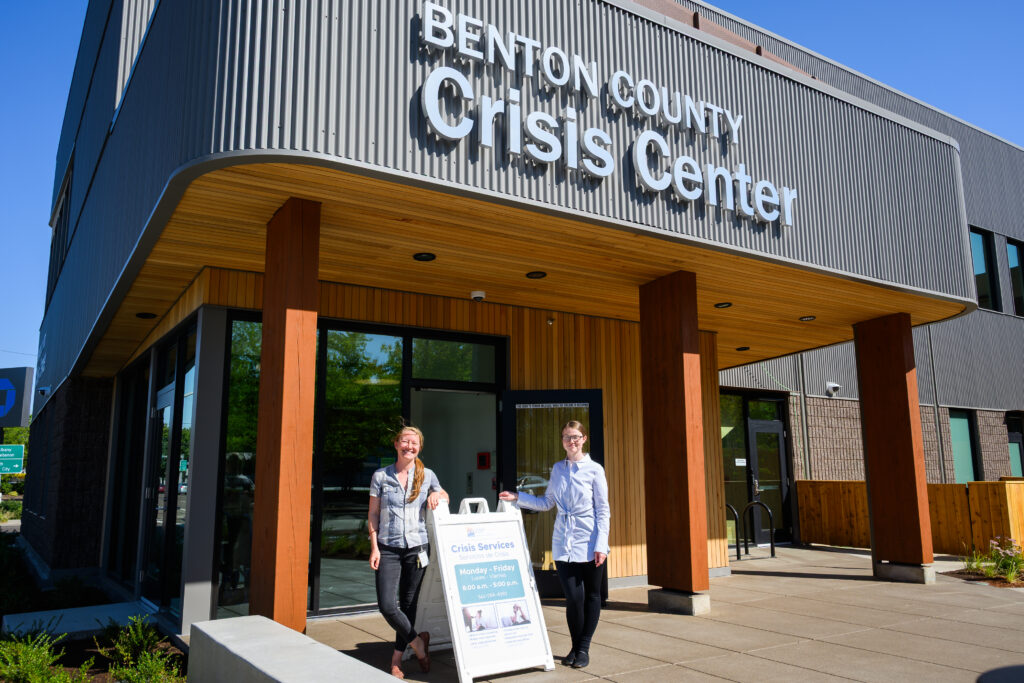
The Benton County Crisis Center, a trailblazing behavioral health facility in downtown Corvallis, has put the county on the forefront of emergency mental health support, officials said.
After approximately eight years of planning, the crisis center opened its doors July 7. One of roughly four similar facilities across the country, officials say the $9 million building will meet a crucial need and prevent involvement of law enforcement and emergency rooms.
The location marries immediate and long-term mental health support, officials said, providing a range of voluntary services rarely offered in one setting.
The center, located at 240 N.W. 4th St., is currently open from 8 a.m. to 5 p.m. on weekdays. Services include crisis counseling, support and referrals to other resources like housing or more advanced behavioral health care. The county aims to offer 24-hour support by the beginning of next year, officials said.
“It’s thrilling because it has taken a long time,” said County Commissioner Pat Malone, who helped secure funding for the project. “We lost a year with permits (and) paperwork, but the people involved had the vision.”
As part of that vision, officials said, the facility adopted a “no wrong door” policy, allowing people with different backgrounds to access its services, regardless of their ability to pay. The county drew inspiration from the Deschutes County Stabilization Center in Bend, though that facility offers shorter respite services, said Crisis Program Manager Hailey Clark.
“It’s a wonderful symbol of a community wanting to take care of itself,” said Benton County Behavioral Health Director Damien Sands.
Officials planned for a $7.7 million price tag on the building, but unforeseen construction complications pushed the project’s timeline and inflated its price. Despite the increased cost, Sands views the center as a long-term investment in the community.

The center also connects people to other resources, such as therapy and addiction treatment services. The facility is not equipped to manage all mental health needs, Sands said, but it can direct those in crisis to more comprehensive resources.
“Oftentimes we’re the step between the hardest step and the next step,” Crisis Program Manager Alia Gehr-Seloover said.
Supporting others in their most vulnerable moments can be taxing, said Gehr-Seloover, and building community in the workplace is imperative.
“We come to work for the clients and we also come to work for each other,” said Gehr-Seloover.
Those walking into the center will notice its calming colors, shapes and furniture designed to comfort people in an altered state of mind, said project manager Ricky Garcia. The building’s usage of a “biophilic” color scheme and natural light help foster a positive environment, Garcia said.
On the second floor, the building will have six bedrooms and a living space including a balcony and garden, kitchen and lounge. Residents will be able to stay for up to 29 days. That space won’t open until at least January, Garcia said.
To create a safe environment for visitors and staff, the building features specialized fixtures, including removable door hinges, seatless toilets and break-away curtains, as well as alarms and ample access to exits for staff and visitors. Even the plants outside were chosen because they are harmless to eat, Garcia said.
The center has a separate law enforcement entrance, preventing disruptions and ensuring that people detained by police can be dropped off “with dignity,” Garcia said.
The county expects a phased opening, though this schedule is dependent on staffing. This fall, the center aims to expand to seven days per week with 10-hour days, with the end goal of reaching 24 hour service by Jan. 1, said Garcia.
Staffing challenges could alter that timeline, he said. The center has 11 employees, while 39 are required for 24/7 care, said county spokesperson Carly Fredericks. While qualified mental health professionals are in high demand, the county will partner with local universities to provide internships and increase staffing.
Funding is also a concern, Garcia explained. While the official cost of operation has yet to be determined, federal Medicaid cuts are expected to affect the fiscal support, said Sands, as Oregon’s qualifying population is expected to shrink by 18%.
For those involved, the crisis center is more than a project — it’s a promise to the community, staff said, and it’s one they intend to keep.
“It’s a visual reminder that these services exist,” said Gehr-Seloover. “That people have a safe place to go and that someone is here to help.”
Clarification: A previous version of this story said the Deschutes County Stabilization Center offered involuntary services. That crisis team used to aid in civil commitment investigations, according to county documents, but no longer does. All walk-in services are voluntary.
— Tashvi Khare, Westview High School
— Lauren Shein, Summit High School